
7,258,491 hotelsin 60 categories

Chelsea Market fills a full city block of a former Nabisco factory, the building where the Oreo was invented, with a warren of food stalls, a scatter of shops and a permanent lunchtime crowd. The trick is knowing what to line up for before you are standing hungry in the middle of it.
We at Travelmyth, the hotel search engine that ranks stays by your interests and needs across 60 stay categories, put this guide together so you arrive with a plan rather than a growl in your stomach. Here is how to eat well, what the building actually is, when to go, and how it connects to the High Line right outside. It is a companion to our wider guide to things to do in New York City.
Chelsea Market is a food hall, so the winning strategy is not one meal but several small ones. Walk the whole concourse once before you commit: the stalls run from tacos and lobster rolls to bakeries, ice cream and coffee. Then double back to the two or three that pulled you in, and share plates rather than filling up at the first counter. Tenants change over the years, so treat any specific stall recommendation you read as a starting point, not gospel, and pay attention to the queues: a busy counter is often worth a second look.

Half the pleasure of Chelsea Market is the room it is in. The complex grew out of a group of late-19th-century bakeries that became part of the National Biscuit Company, later known as Nabisco, after the company was formed in 1898. It was here that the Oreo cookie was invented and produced. The conversion kept the industrial bones of the old factory, which is why the place feels like nowhere else you will eat in the city. It fills an entire city block, bounded by Ninth and Tenth Avenues and 15th and 16th Streets, so there is more of it than first appears.
Chelsea Market is a shopping mall as well as a food hall, so it is worth a browse between bites. Alongside the food stalls are shops worth a browse, a good place to pick up something that is not a fridge magnet. It is also an office building with media and production spaces, so parts of it are working space rather than public market; stick to the ground-floor concourse and you will find everything a visitor wants.
The one rule is to avoid the lunch crush. Lunchtime and weekends tend to be the busiest periods, when the concourse can become very crowded and lines lengthen. Come mid-morning or mid-afternoon on a weekday and it is a different, far more pleasant place. Budget 45 minutes to an hour to eat and browse, or longer if you are pairing it with a walk on the High Line.

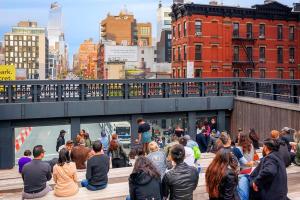
Chelsea Market and the High Line are made to be done together. The first section of the High Line, the elevated park built on a former railroad spur, opened in 2009. The park runs along Chelsea Market’s Tenth Avenue side through the Chelsea Market Passage, with access at West 16th Street immediately beside the market. Eat first, then walk the High Line north or south, the natural one-two of a West Side afternoon.

Basing yourself in Chelsea or the neighboring Meatpacking District puts Chelsea Market, the High Line and the Hudson River waterfront at your door, in one of the most walkable corners of Manhattan. On Travelmyth you can filter New York stays by the features that matter to you: a boutique-style property, a historic stay, a rooftop pool or a family-friendly property. You can combine two of those filters at once to narrow the long list to the handful that fit how you travel.